
COMPONENT REFERENCE / POWER
MOSFETs & power semiconductors
Choose around voltage stress, switching behaviour and the thermal path. Silicon MOSFETs, superjunction devices, SiC, IGBTs and rectifiers offer different trade-offs; a shared package does not make them interchangeable.
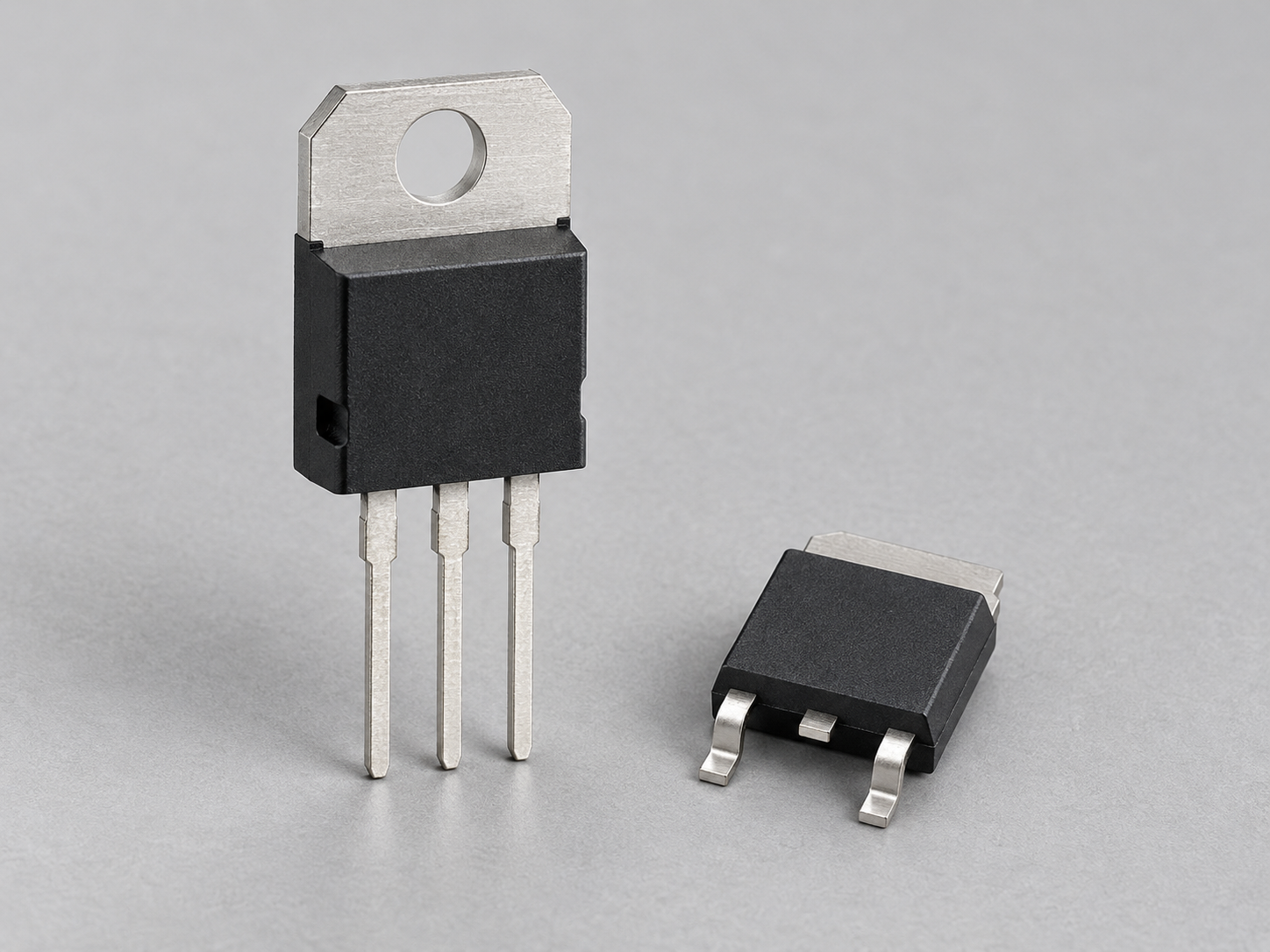
How the range is organised
Blocking voltage
Blocking voltage and actual transient envelope.
Conduction mechanism
Conduction mechanism: resistive MOS channel / conductivity-modulated IGBT / diode rectification.
Switching conditions
Commutation: hard/soft switching, reverse recovery, dead time and edge rate.
Thermal path
Thermal/mechanical system: PCB cooled discrete / heatsink mounted discrete / module.
A useful first comparison
| Family | Circuit job | First comparison | Common mistake |
|---|---|---|---|
| Low- and medium-voltage silicon MOSFETs | Battery and medium-voltage switching | Hot RDS(on), gate charge, SOA | VGS(th) is not a drive recommendation |
| High-voltage superjunction MOSFETs | High-voltage silicon conversion | RDS(on), Qoss/Eoss, diode commutation | Voltage plus resistance is insufficient for substitution |
| Silicon carbide MOSFETs | High-voltage fast conversion | Drive window, measured energy, loop inductance | Fast edges require the whole power stage to change |
| IGBTs | High-voltage/current conversion at suitable frequency | VCE(sat), Eon/Eoff, diode and protection | Current nameplate is not fault immunity |
| Rectifiers and Schottky diodes | Unidirectional power paths | VF + leakage + recovery + thermal path | Lowest VF alone may increase hot losses |
Compare under the same temperature, test fixture and operating conditions. A family name is not a complete specification.
Compare the types
Low- and medium-voltage silicon MOSFETs
Match gate drive, hot resistance, switching charge and real board cooling.
Read the guideMOSFETs & power semiconductorsHigh-voltage superjunction MOSFETs
High-voltage silicon efficiency depends on the topology and body diode.
Read the guideMOSFETs & power semiconductorsSilicon carbide MOSFETs
High-voltage switching gains require a suitable driver and a controlled loop.
Read the guideMOSFETs & power semiconductorsIGBTs
Balance on-state drop against switching tail loss at the intended duty.
Read the guideMOSFETs & power semiconductorsRectifiers and Schottky diodes
Choose the junction and package from forward, reverse and recovery losses.
Read the guideSOURCING IN CHINA
What Chinese suppliers can offer
Domestic portfolios include silicon MOSFETs, superjunction parts, SiC, IGBTs and rectifiers. Jilin Sino-Micro and Silan provide multiple process and package directions; CR Micro and Yangjie add further candidates in SiC and rectification. This widens the options for second sourcing and package-constrained designs. To establish an advantage, compare hot losses, drive changes, heatsinking and qualification costs together with the quotation.
Start with the right questions
- Request an exact ordering code and current datasheet.
- Compare samples under your actual electrical and thermal conditions.
- Confirm the supply route, traceability and change-notification arrangements.
These guides explain selection principles. Final decisions require the current datasheet for the exact ordering code, operating conditions and appropriate application testing.
Discuss this component