
COMPONENT REFERENCE / INDUCTORS
Inductors & EMI magnetics
Start with the circuit’s job. Energy-storage inductors, RF inductors, common-mode chokes and ferrite beads solve different problems, even when their packages look similar.
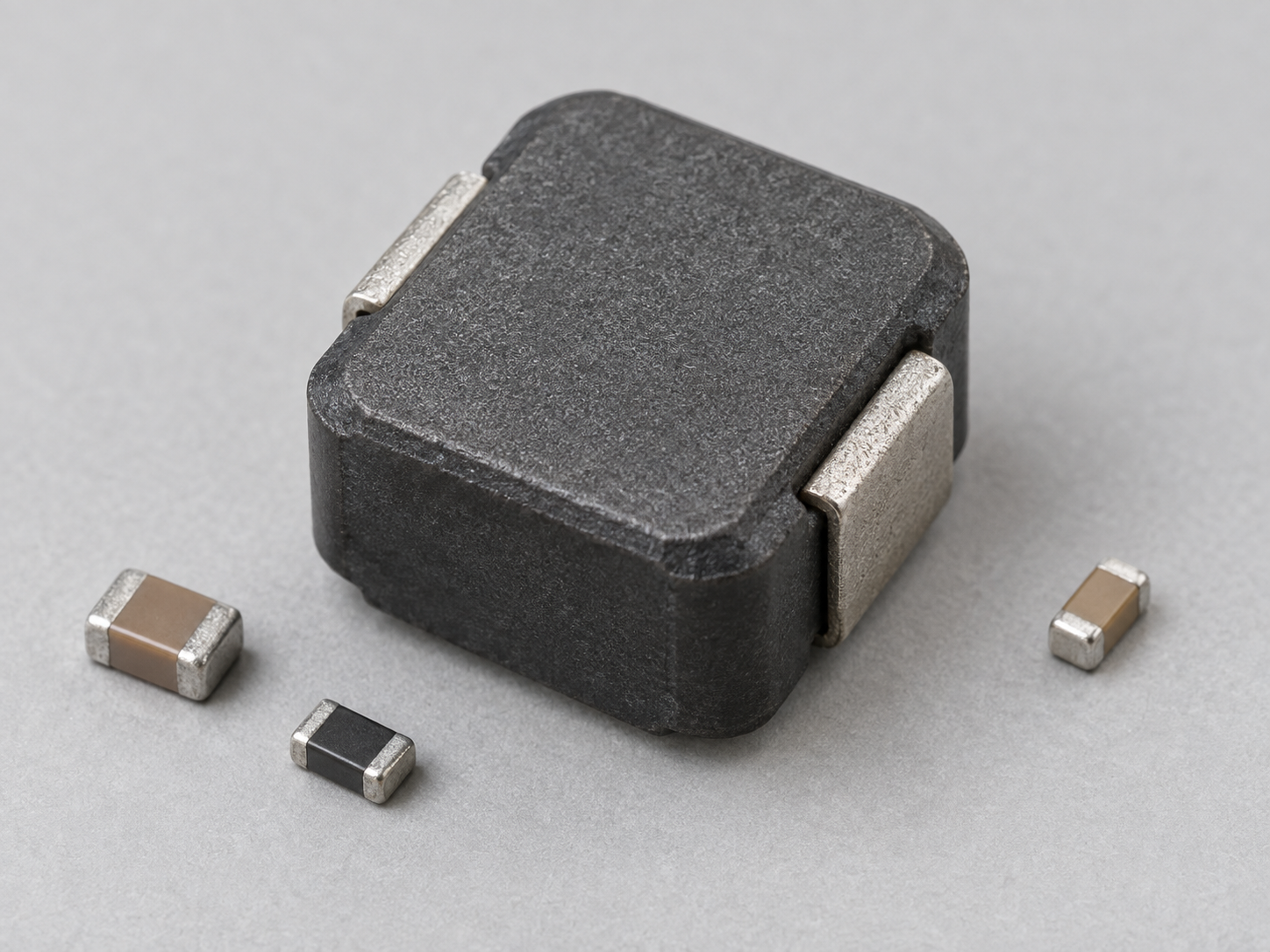
How the range is organised
Circuit purpose
Circuit purpose: store energy / tune impedance / suppress common-mode current / dissipate noise.
Construction
Construction: molded composite / gapped ferrite / ceramic multilayer or wirewound / coupled windings.
Operating stresses
Stress: DC bias, ripple frequency, signal bandwidth, ambient plus self-heating.
A useful first comparison
| Family | Circuit job | First comparison | Common mistake |
|---|---|---|---|
| Molded / composite power inductors | Energy storage in compact DC/DC | Effective L, Isat definition, total hot loss | Soft saturation is not unlimited current |
| Ferrite power inductors | Energy storage where loss and size can be traded | Hot saturation knee, core loss, DCR | Ferrite is not automatically inferior to molded |
| RF inductors | Frequency-selective reactance | Q/L/SRF at the actual RF band | Same nH does not imply the same matching |
| Common-mode chokes | Reject common-mode noise on a pair | Common-mode attenuation plus signal integrity | Does not solve every differential-noise problem |
| Ferrite beads | Dissipate high-frequency rail noise | Biased R/X/Z, DCR, resonance | Not a converter storage inductor |
Compare under the same temperature, test fixture and operating conditions. A family name is not a complete specification.
Compare the types
Molded / composite power inductors
Compact energy storage; select on effective inductance, peak current and hot loss.
Read the guideInductors & EMI magneticsFerrite power inductors
Compare core and copper loss before choosing the smallest package.
Read the guideInductors & EMI magneticsRF inductors
The right nH value still needs the right Q and parasitics at your frequency.
Read the guideInductors & EMI magneticsCommon-mode chokes
Suppress the unwanted current mode while preserving the differential signal.
Read the guideInductors & EMI magneticsFerrite beads
A lossy noise filter whose impedance changes under DC load.
Read the guideSOURCING IN CHINA
What Chinese suppliers can offer
Sunlord lists molded, wound, RF and bead ranges; CODACA also describes custom magnetic design and material or core adjustments. For a design constrained by height, pins or hot losses, compare two standard domestic options with one custom proposal. Local engineering communication can make sample revisions easier to coordinate. Tooling, MOQ, annual volume and validation effort determine whether customization actually improves the project economics.
Start with the right questions
- Request an exact ordering code and current datasheet.
- Compare samples under your actual electrical and thermal conditions.
- Confirm the supply route, traceability and change-notification arrangements.
These guides explain selection principles. Final decisions require the current datasheet for the exact ordering code, operating conditions and appropriate application testing.
Discuss this component